Skip to content
You send the text and then you watch the phone like it owes you money. Three dots appear, then vanish. An hour goes by. By the time they finally write back “sorry, busy day,” you’ve already run the whole movie: they’re losing interest, you came on too strong, you should play it cool next time. You hate how much their silence can run your nervous system. You also can’t seem to stop it.
That push-and-pull is the signature of an anxious-avoidant relationship, and if it’s yours, you already know how lonely the middle of it feels.
Meanwhile, the person on the other end isn’t plotting anything. They felt the pull of the conversation getting intense, something in them tightened, and they put the phone face-down to “deal with it later.” They love you. They also need to come up for air in a way you find baffling and a little insulting.
If this is your relationship, you’re caught in what therapists call the anxious-avoidant cycle: one partner leans anxious and reaches for closeness when stressed, the other leans avoidant and reaches for space. I’m Raber, a couples therapist in St. Louis, and this is one of the most common patterns I see. It’s also one of the most painful, because the harder each person tries to feel okay, the worse they make the other feel. The good news that almost nobody tells you up front: this is a pattern, not a life sentence, and the pattern is the most workable part.
Let me show you what’s going on, why you two found each other, and how couples climb out.
What anxious and avoidant attachment really mean
Attachment theory started with babies and the people who cared for them, and researchers later found similar patterns show up in adult love. The short version: your earliest experiences taught your body a strategy for what to do when you need someone and aren’t sure they’ll be there.
If reaching out mostly worked, but not reliably, you may have learned to turn the volume up: protest, pursue, make sure you’re not being left. That’s the anxious lean. If reaching out mostly brought disappointment or felt like too much, you may have learned to turn the volume down: handle it yourself, need less, keep some distance for safety. That’s the avoidant lean. I’ve written a full guide to each one: the anxious attachment style and the avoidant attachment style.
Two things matter here before we go further, and the whole rest of this post depends on them.
First, these are leanings, not labels stamped on your forehead. Researchers measure attachment as two dials, how much anxiety and how much avoidance you carry, and most people land somewhere in between and shift over time and across relationships. You might lean more anxious with this partner than you did with a past one. “I’m an anxious person” is the kind of fixed story that keeps you stuck. “I tend to use anxious strategies when I feel disconnected” is true and changeable.
Second, neither strategy is the broken one. The chase and the wall are both smart solutions a younger version of you came up with to stay safe. They only become a problem when they meet each other.
Why anxious and avoidant people attract each other
It can feel like a cruel joke that the two leanings so often pair up. There’s a reason, and it isn’t bad luck.
In the early days, the fit is electric. The anxious partner finally feels the intensity they’ve always craved, and someone who seems like a puzzle worth solving. The avoidant partner feels wanted, pursued, warmed up by someone who isn’t afraid to express feeling. As one Gottman Institute writer puts it, we tend to attract partners who are about as emotionally available as we are, and the contrast between you reads at first as chemistry.
Then real life arrives. The relationship gets close enough to matter, which means it gets close enough to threaten. And the same difference that felt like magnetism starts working in reverse.
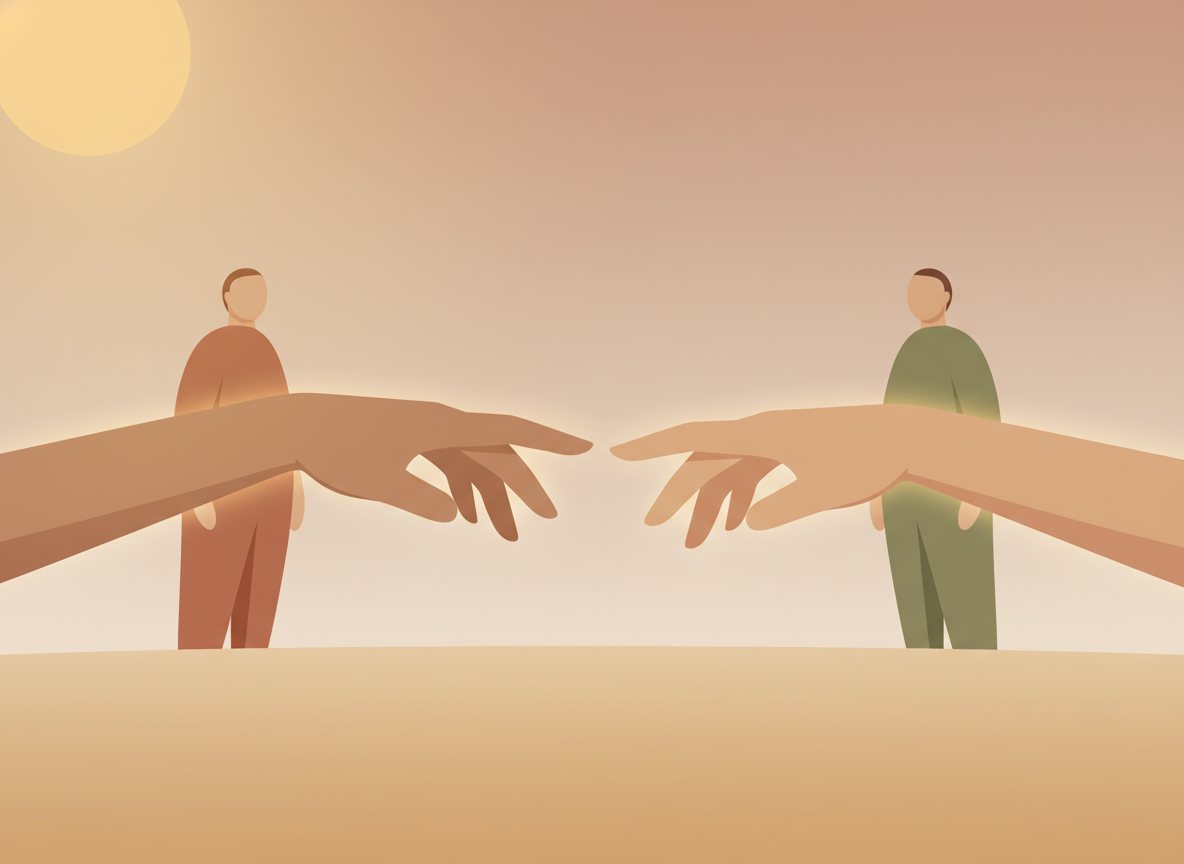
The anxious-avoidant trap: how each partner’s coping triggers the other’s wound
Here’s the trap in one breath. The anxious partner’s bid for closeness reads as pressure to the avoidant partner, who pulls back to breathe. That pullback reads as abandonment to the anxious partner, who pushes harder to reconnect. The harder push confirms the avoidant partner’s fear that closeness means losing yourself, so they retreat further. Around and around, each person’s attempt to feel safe sets off the other’s deepest alarm.
What makes it diabolical is the timing. Stress fires both systems at once, so the trap snaps shut exactly when you both most need each other. The night before a big move, the week money is tight, the moment after a scary doctor’s visit. Right when connection would help most, the chase-and-retreat machine kicks into high gear.
If your version of this dynamic explodes mid-argument, with raised voices, then a total shutdown, that’s a specific moment worth its own playbook. I walk through the physiology of it and the 20-minute reset in a separate guide on stonewalling and shutting down during arguments. This post stays at a higher altitude: the pattern across your whole relationship, not just the blowups.
Protest behaviors: what the chasing looks like
When you lean anxious and the distance opens up, your attachment system sounds an alarm, and the alarm makes you do things. Attachment researchers call these protest behaviors. They’re bids for connection written in a language that, sadly, tends to push your partner away.
You might recognize a few:
- Texting again. And again. Watching the read receipt like a hawk.
- Bringing up the relationship’s status to get reassurance, then not believing the reassurance.
- Keeping score of who reached out last.
- Threatening to leave, hoping they’ll finally fight for you.
- Going cold or pulling back yourself, so they’ll notice and come find you.
- Picking a fight because a fight is at least contact.
Read that list gently. None of it makes you manipulative or “too much.” Every item is a smoke alarm going off, a part of you that learned love can vanish and is trying, clumsily, to make sure it doesn’t. The trouble is that an alarm blaring in your partner’s face rarely makes them want to move closer.
The shift that helps is to find the need under the protest and ask for that instead. Under “why didn’t you text back” is usually “I got scared we were drifting and I need to know we’re okay.” One of those starts a fight. The other starts a conversation.
Deactivating strategies: what the pulling away looks like
Now the other seat, and this section matters whether you lean avoidant yourself or you’re trying to understand a partner who does. When you lean avoidant and closeness starts to feel like too much, your system turns the volume down. Researchers call these deactivating strategies, and from the outside they look like not caring. From the inside they’re something else entirely.
They can look like:
- Suddenly noticing all your partner’s flaws right when things were getting close.
- Thinking about an ex who, conveniently, asked nothing of you.
- “I’m just not ready,” held open indefinitely.
- Burying yourself in work when the relationship heats up.
- Letting texts sit. Going quiet. Needing the trip, the game, the garage.
- Holding back the “I love you” you actually feel.
If you’re the avoidant-leaning partner, this part is for you. The distance isn’t the absence of feeling. It’s a wall built over feeling. A part of you learned somewhere that needing people ended in disappointment or got you swallowed whole, so it got good at not needing. The numbness often arrives before you’ve even chosen it, and underneath it, more often than your partner could guess, is real longing and the ache of watching them hurt and not knowing how to cross the distance. You’re allowed to find this hard. You’re also the only one who can start lowering the wall, and your partner cannot do it for you.
When the anxious partner can see the wall as protection instead of rejection, and the avoidant partner can see the chase as fear instead of control, something softens. You stop being each other’s villain.
Your parts are running the show (and you are not your parts)
One of the models I work from, Internal Family Systems, gives couples a kinder way to hold all this. The idea is that we each carry parts, little inner roles that step in to protect us, and a calm core Self underneath them.
In the anxious-avoidant trap, two protectors are doing battle. Your partner’s wall-builder stands guard over a younger part that learned having needs led to hurt. Your hypervigilant part scans for the smallest sign of distance, guarding a younger part that learned love could disappear without warning. Both protectors are loyal. Both are exhausting. And neither one is the truth about who you are.
That reframe, you are not your protector and neither is your partner, does something a comparison chart never can. It turns “you’re so avoidant” and “you’re so needy” into “our scared parts are running this, and we can lead from somewhere calmer.” This is the same ground the relationship stands or falls on, the felt sense of emotional safety that lets a guarded person risk being known.
What attachment TikTok gets right, and what it gets wrong
You probably didn’t learn these words in a therapy office. You learned them on TikTok, or from a quiz, or from a friend who diagnosed your whole dating history in one brunch. Some of that is genuinely good.
What the internet gets right: It gave millions of people language for a pattern they couldn’t name. It reduced shame, because “my nervous system learned this” is easier to hold than “I’m broken.” And it helps people spot a dynamic before it wrecks another five years.
What it gets wrong is worth slowing down for:
- Styles aren’t horoscopes. You’re not “an anxious” the way you’re a Virgo. Attachment shifts with who you’re with and changes over time. A free online quiz is a snapshot of a mood, not a verdict on your character.
- Avoidant doesn’t mean narcissist. The internet collapses these constantly, and it’s doing real harm. Deactivating is a protective habit. Calling it cruelty or a personality disorder gets it badly wrong. The same goes the other way: anxious protest gets labeled “toxic,” when it’s really fear turned up loud. Both are scared people coping.
- Labels make terrible weapons. The second “you’re just being avoidant” enters a fight, you’ve stopped talking to your partner and started talking to a category. Nobody softens while being diagnosed.
Use the words to understand yourself with curiosity. Be slow to use them on anyone else.
Can an anxious-avoidant relationship work?
Yes, with honesty about what it asks of you. The pairing is genuinely harder, and on average less smooth, than two secure partners. It is not doomed. Two things have to be true: both of you can eventually see the cycle as the problem instead of blaming each other, and each of you is willing to own your own half of it.
What changes the odds isn’t finding a more secure partner. It’s that security can be built in adulthood, through repeated experiences of reaching for each other and being met. Couples do this all the time. They don’t become different people. They become a safer team.
A word of honesty about when to think harder. The pattern is workable when there’s no contempt, when distance is overwhelm rather than punishment, and when both of you can repair after a rupture. It’s a different situation when the silence is used to control you, when “I need space” is really a way to keep you anxious and compliant, or when one partner has refused every attempt at repair for years. And if you ever feel afraid of your partner, this isn’t a communication pattern to fix together. That deserves its own support. The National Domestic Violence Hotline (800-799-7233) is free, confidential, and there around the clock.
How to break the anxious-avoidant cycle
Here’s the part you came for. A move that helps comes from Emotionally Focused Therapy, developed by Sue Johnson and Les Greenberg, and it starts with a mental flip: the cycle is the enemy, not your partner. You’re not two opponents. You’re two people getting clobbered by the same loop, and you can turn and face it together.
Underneath every round of the loop is one question each of you is asking: are you there for me? Johnson boils a secure bond down to three words, A.R.E. Are you Accessible, Responsive, Engaged? Most of the fighting is a sloppy attempt to get a yes.
If you lean anxious
Your work is to let the alarm sound without acting on it instantly. When the distance opens and the urge to chase rises, name it to yourself: my system thinks I’m being abandoned; that’s the old wound, not necessarily tonight’s reality. Then ask for what you actually need, plainly, instead of protesting.
Try: “I’m feeling a little disconnected and I’d love ten minutes of your attention tonight.” That’s a request a partner can say yes to. “You never make time for me” is a charge they can only defend against.
If you lean avoidant
Your work is to stay reachable while you take the space you genuinely need, and to come back. Space with a return time is a gift. Space that just evaporates is the thing that terrifies your partner.
Try: “I’m getting overwhelmed and I need a bit. Give me an hour and I want to come back to this, I’m not disappearing.” Then actually come back. The re-entry is the part avoidant-leaning folks most often skip, and it’s the part that rebuilds trust fastest.
As a couple
There’s a sequence here that almost no online article mentions, and it matters. In EFT, the withdrawing partner usually needs to become more reachable before the pursuing partner can fully soften. The distance is what the anxious partner can’t tolerate, so a little more presence from the avoidant partner is what lets everyone’s nervous system come down.
Build a shared move for the moment you catch yourselves spinning: “We’re doing the thing. Can we start over?” Said by either of you, it pulls you both out of your corners and points you at the cycle instead of each other. None of this requires you to stop being who you are. It asks you to lead from your calmer self instead of your scared part.

Earned security: becoming a safer team
There’s a name for where this is headed: earned security. It means you didn’t start out secure, and through enough honest, repairing relationship experience, you grew into it. It’s a real, studied thing, not a motivational poster. Research on earned security suggests that some adults who grow into it go on to build steady, secure bonds, though it’s still a debated area.
Keep your expectations human, though. Earned security isn’t a glow-up where you wake up healed and never anxious again. It’s a direction, built from hundreds of small moments where one of you reached and the other reached back. You’ll still have your leanings. They’ll just stop running the relationship.

What this looks like in my office
Picture a St. Louis couple, together four years. She came in convinced he was checked out. He came in convinced he could never do enough. In the first session or two, we don’t try to fix either of them. We put the cycle up on the whiteboard and watch it move: her worry, his retreat, her louder bid, his deeper wall. The first time they see it as one shared loop instead of two character flaws, the room changes.
From there the work is slow and concrete. He practices saying “I’m overwhelmed, give me an hour, I’ll be back,” and practices coming back. She practices catching the alarm and asking for closeness without the protest. The fights get shorter. The repairs get faster. They don’t morph into different people. They become a team their own nervous systems can finally trust. That’s the arc, and I get to watch some version of it regularly in couples therapy here in St. Louis and online across Missouri.
And if your partner isn’t ready to come yet, you are not powerless. A cycle has two ends, and it shifts when either person stops pulling their rope the same way. Individual therapy is a strong place to start changing your half.
Questions people ask about anxious-avoidant relationships
Do anxious-avoidant relationships last?
They can, and plenty do. The pairing is harder than average, but length isn’t really the question. What matters is whether both people can learn to see the cycle and repair after ruptures. Couples who build that skill often end up closer than they were before the trouble started.
Do avoidant partners actually love their partners?
Usually, yes, and often deeply. Leaning avoidant isn’t a deficit of love; it’s a learned strategy for managing the vulnerability that love brings. The feeling is frequently there behind the wall, even when it’s hard to show. That said, love alone doesn’t dissolve the pattern. Showing up does.
How do anxious-avoidant relationships end?
One ending clinicians see a lot is exhaustion. The reaching partner finally gives up after years of trying, often right as the other starts to realize what they’re losing. It’s a sad mistiming, and it’s also avoidable when the cycle gets named and addressed early enough.
Can an avoidant person become securely attached?
Yes. Attachment isn’t fixed. Through a steady relationship where taking small risks of closeness gets met with safety instead of engulfment, the avoidant nervous system can slowly learn that needs are allowed. It’s gradual, and it’s real.
Can you fix an anxious-avoidant relationship if only one person is working on it?
One motivated person can still move the cycle, because you can only spin it together. When you change your part, protest into clear requests, or vanishing into space-with-a-return, your partner’s part has nothing to push against. Many couples start with one person in individual therapy and find the relationship shifts from there.
Can couples therapy help an anxious-avoidant relationship?
This is close to what couples therapy was built for. The approaches I use, Emotionally Focused Therapy, the Gottman Method, and Internal Family Systems, are all designed to slow this exact loop down, make it visible, and help two guarded people reach each other on purpose. You can read more about how I work if you’re curious whether it fits.
Where to start
If you recognized yourself and your partner in here, take that as good news, not bad. You can’t change a pattern you can’t see, and you just saw it clearly.
This week, try one small thing. If you lean anxious, the next time the alarm goes off, name the need under it before you act. If you lean avoidant, the next time you take space, give it a return time and keep it. One reach, met once, is how the whole thing starts to turn.
One honest note: this post is for learning, not a diagnosis of you or your partner, and no article can promise a particular outcome. What it can do is hand you a map that most couples never get.
You’re not too much, and your partner isn’t cold. You’re two people whose old survival strategies happened to collide, and collisions like that can be unlearned. If you’d like company for that work, I’d be glad to meet you, together or on your own. You can request an appointment whenever you’re ready. Either way, the next reach can go differently than the last one.